Building a KopiO Old Fashioned Without Losing the Coffee
The Old Fashioned does not forgive imbalance. There is nowhere for sweetness to hide and nowhere for coffee to disappear. If a coffee liqueur can hold its place here, it can hold its place anywhere — and this is exactly where KopiO proves its structure.
The Old Fashioned is one of the most unforgiving cocktail structures. With no citrus juice, no carbonation, and no dilution beyond ice, every ingredient is fully exposed. This makes it a challenging format for coffee liqueur. Too much sweetness and the drink turns syrupy. Too much bitterness and the coffee disappears into oak and alcohol. Too much spirit and the coffee becomes decorative rather than structural.
Building a KopiO Old Fashioned requires a different mindset. The goal is not to turn the drink into a coffee cocktail, but to let coffee sit inside the Old Fashioned structure without being drowned out or overstated. When done correctly, the coffee feels integrated, dry, and deliberate.
KopiO is particularly well suited to this role because it was designed with restraint and balance rather than dessert richness. Developed by Studio Origin, it carries coffee flavour clearly without relying on excess sugar or viscosity. That process-led design is central to KopiO’s development at Studio Origin.
Why Coffee Old Fashioneds Often Fail
Most coffee-forward Old Fashioned variations fail for one of three reasons.
The first is sweetness. Many coffee liqueurs are already sugar-heavy, and when paired with bourbon or rye, the drink becomes cloying within a few sips.
The second is bitterness. Coffee bitterness layered on top of oak tannin and alcohol heat can quickly feel abrasive.
The third is proportion. Coffee liqueur is often added as an afterthought, either disappearing completely or overwhelming the base spirit.
A successful KopiO Old Fashioned treats coffee as a structural modifier rather than a flavour garnish.
KopiO Old Fashioned Recipe
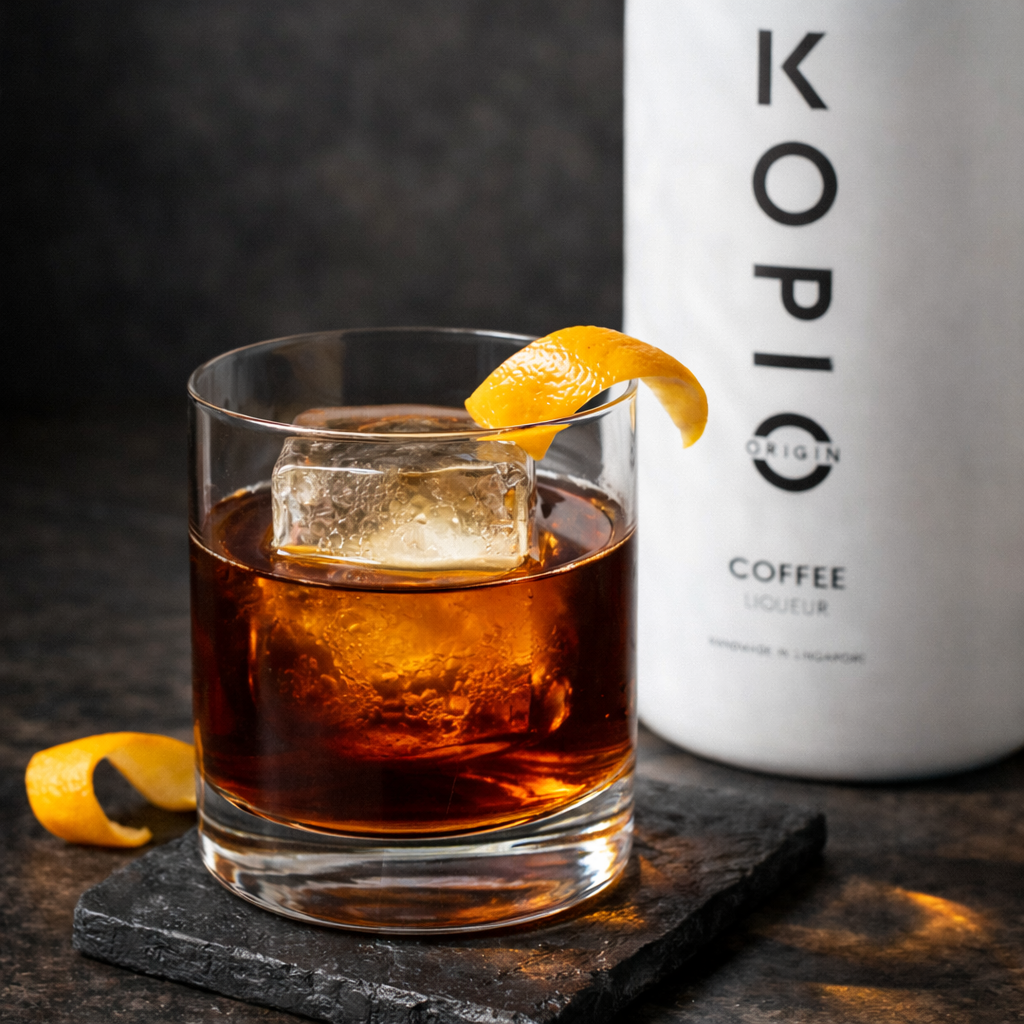
This recipe is designed to preserve the identity of an Old Fashioned while allowing coffee to remain clearly present.
Glass
Rocks glassIce
One large, dense ice cubeIngredients
45 ml quality bourbon or rye whiskey
15 ml KopiO coffee liqueur
1 dash aromatic bitters
Orange peel (expressed only)Build
Add KopiO and bitters directly to the glass.
Add the whiskey and stir gently to integrate.
Add a large ice cube and stir slowly until lightly chilled and diluted.
Express an orange peel over the surface and discard.
This ratio keeps coffee visible without pushing the drink into sweetness or novelty territory.
Why These Proportions Work
The 3:1 ratio between whiskey and KopiO is intentional.
At this level, KopiO replaces the role of sugar rather than sitting on top of it. Its controlled sweetness softens the whiskey while its coffee character adds depth instead of flavour clutter. The drink remains recognisably an Old Fashioned, not a flavoured variation.
Because KopiO is designed with restraint, it does not collapse into syrup when used this way. This same structural balance is what allows it to perform reliably in other precision-driven formats, such as the Espresso Martini, where coffee must remain clear without dominating the drink. That relationship is explored in detail in the discussion of why the right coffee liqueur matters for the Espresso Martini.
Choosing the Right Base Spirit
Spirit choice matters more here than in most coffee cocktails.
A bourbon with heavy vanilla sweetness will push the drink toward dessert. A rye with too much spice can crowd the coffee. The best results come from a balanced whiskey with moderate oak and controlled sweetness.
The goal is integration, not contrast. Coffee should feel woven into the drink, not layered on top of it.
Bitters and the Coffee Question
Only a single dash of aromatic bitters is needed.
Bitters should frame the drink, not compete with coffee bitterness. More than one dash risks pushing the drink into dryness and pulling focus away from the coffee.
If variation is desired, bitters should be adjusted cautiously and sparingly. The structure of the drink should remain intact.
Texture and Finish
This drink should feel dry, composed, and slow.
KopiO’s controlled mouthfeel allows the Old Fashioned to remain clean on the finish rather than sticky or lingering. Coffee appears mid-palate, then fades, allowing oak and alcohol warmth to resolve naturally.
This clean finish is one of the reasons KopiO adapts well beyond short cocktails, including cream-based drinks and desserts, where heaviness would otherwise become a problem. Its versatility across formats is reflected throughout the KopiO range available via Origin Crafted.
When to Serve This Drink
This KopiO Old Fashioned is best suited for late evening drinking, slow sipping, or moments where a traditional Old Fashioned might feel appropriate but something slightly softer is desired.
It works well for guests who enjoy coffee flavour but dislike sweet coffee cocktails. It is also an effective bridge drink for whiskey drinkers curious about coffee liqueur without wanting a radical departure from classic structure.
Minimal Variations Only
If adjustment is needed, keep it disciplined.
A slightly different whiskey will change emphasis. A different aromatic expression from the peel will shift the top notes. What should be avoided are syrups, extra sugar, or additional liqueurs.
The strength of this drink lies in its restraint.
Why KopiO Holds Its Ground Here
Old Fashioneds expose weak structure immediately. Coffee liqueurs built around sweetness or viscosity tend to collapse under this pressure.
KopiO’s ability to hold its place reflects its process-led design and its suitability for professional use, where drinks must remain balanced without constant adjustment. That reliability is one reason it is trusted in hospitality settings, as outlined in Origin Crafted’s trade and retail focus.
See How KopiO Adapts Across Formats
The Old Fashioned shows how KopiO integrates into spirit-forward classics without collapsing into sweetness. In tighter, espresso-led builds like The Espresso Martini Done Properly – Why the Right Coffee Liqueur Matters, that same restraint keeps coffee clear and structured rather than heavy.
In softer applications such as the KopiO White Russian, balance prevents cream from flattening the drink. And in dessert expressions like KopiO Chocolate Mousse, KopiO enhances flavour without turning the dish overly sweet. Each format tests structure differently — and each reveals why restraint matters.
A Coffee Old Fashioned Done Properly
This KopiO Old Fashioned shows that coffee does not need to shout to be present.
When proportions are correct and the liqueur is built with restraint, coffee becomes part of the structure rather than a novelty. The result is a drink that respects both traditions—coffee and whiskey—without forcing either to compromise.